
Services
ITAM Governance, Trusted Data, and Operational Control

iiTechByDesign helps organizations strengthen IT asset governance, clarify ownership, validate lifecycle controls, improve CMDB data quality, and establish practical operating foundations.
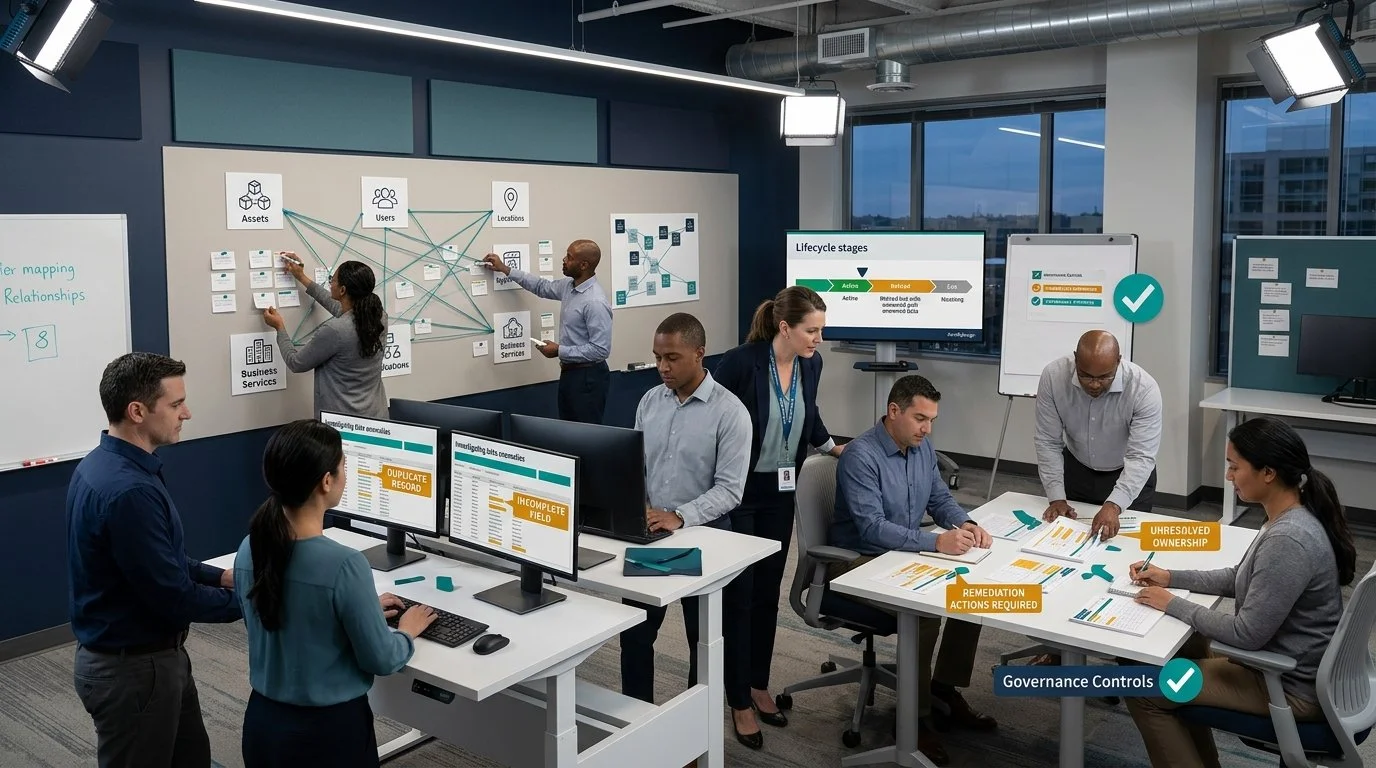
Every engagement begins with the business problem—not a predetermined platform, product, or deliverable. We determine what is actually happening, what the available evidence supports, and what should be addressed first.
Our primary services address the governance, ownership, data, lifecycle controls, evidence, and operating practices required for trustworthy technology asset management. The right engagement is selected through a focused discovery conversation.
Focused Services for Stronger ITAM Foundations

-
Establish a defensible view of how technology assets are governed, controlled, documented, and supported by evidence.
Designed for Organizations experiencing unclear ownership, inconsistent lifecycle practices, unreliable reporting, audit pressure, control failures, or uncertainty about what should be improved first.
What we assess
Governance structure and decision rights
Asset ownership and lifecycle accountability
Policies, standards, procedures, and operational controls
Asset data and evidence integrity
Hardware lifecycle controls
Vendor and ITAD governance
Documentation and evidence readiness
Technology and integration fitness
Reporting, measurement, and executive oversight
Responsible automation and AI readiness
What you receive
Executive maturity scorecard
Control Maturity and Evidence Confidence results
Systemic findings and root-cause analysis
Ownership and accountability findings
Immediate stabilization priorities
Corrective-action recommendations
90-day improvement plan
Longer-term governance roadmap
Executive decisions and sponsorship requirements
Controls Validation and Audit Readiness
Risk-based asset and evidence sampling
Asset-to-CMDB and cross-repository reconciliation
Receiving, assignment, transfer, recovery, inventory, and disposal controls
Chain-of-custody and data-destruction evidence
Exception and corrective-action ownership
Validation of prior remediation
Audit-evidence readiness
This is an advisory controls and evidence review. It is not a financial audit, SOC examination, accredited ISO certification audit, legal compliance opinion, publisher-specific license audit, or formal attestation.
Typical engagement: 2–3 weeks
-
Improve confidence in configuration data by addressing the ownership, source, reconciliation, exception, and correction problems behind poor CMDB health.
Designed for Organizations experiencing incomplete or stale configuration items, duplicate records, conflicting repositories, unreliable relationships, unclear ownership, reconciliation failures, or recurring cleanup efforts that do not produce lasting improvement.
What we assess
In-scope CI classes and repositories
Completeness, correctness, duplication, and staleness
Authoritative data sources
Identification and reconciliation rules
Data ownership and stewardship
Asset-to-CI alignment
Integration and data-movement dependencies
Exception handling and correction workflows
Root causes behind recurring data-quality failures
Governance and review cadence
What you receive
Validated CMDB health baseline
Critical-CI and repository findings
Ownership and accountability model
Authoritative-source map
Data-quality and reconciliation rules
Root-cause findings
Exception and correction workflow
Prioritized remediation backlog
Executive findings and roadmap
The sprint is platform-neutral. ServiceNow-specific analysis is included when relevant, but the engagement can also address other CMDB platforms, custom repositories, and multi-repository environments.
Available in focused, standard, and enterprise scopes based on the number of CI classes, repositories, integrations, stakeholders, and business units involved.
Typical engagement: 2–3 weeks
-
Establish a governed, migration-ready ITAM operating foundation using Microsoft tools the organization may already own.
Designed for small and growing organizations that have outgrown uncontrolled spreadsheets and email-based processes but may not yet need—or be ready for—a major enterprise ITAM platform.
What we assess
Centralized asset repository
Canonical asset data model
Controlled lifecycle statuses and reference values
Authoritative-source rules
Ownership and access model
Lifecycle and exception controls
Data-quality requirements
Evidence-retention requirements
Administrative documentation
Migration-ready identifiers and exports
Optional components
Selected Power Apps interfaces
Power Automate notifications and approvals
Operational and executive reporting
Data migration and repository consolidation
Future-platform mapping
What you receive
Governed internal ITAM foundation
Data dictionary
Ownership and administrative model
Lifecycle procedures
Approved workflows and reporting
Governance documentation
Migration-readiness package
Implementation and handoff documentation
Final scope, licensing assumptions, delivery window, pricing, integrations, and acceptance criteria are confirmed after discovery and documented in the signed proposal and statement of work.
Typical engagement: 2–4 weeks
Core Services
Some organizations enter through a specific platform or AI-governance decision. These services remain available when discovery confirms that the specialized scope is more appropriate than one of the primary engagements.
Specialized Routes for Defined Needs

-
Determine whether the organization’s governance, lifecycle processes, ownership, data, integrations, controls, and operating model can support a successful ITAM platform decision or initiative.
Designed for organizations:
Selecting an ITAM platform
Preparing for implementation
Expanding existing platform capabilities
Recovering a stalled implementation
Replacing fragmented repositories
Determining whether a platform or governance problem exists
Preparing asset processes and data for AI-enabled automation
This capability can support a broader consulting engagement or operate independently when existing platform reporting does not adequately meet the business need.
What you receive:
Platform-readiness scorecard
Current-state operating-model findings
Repository and authoritative-source inventory
Process, governance, and ownership analysis
Integration and dependency map
Data and automation-readiness findings
Prioritized preparation roadmap
Optional ServiceNow specialization
Typical engagement: Scope and duration depend on data readiness, integration complexity, and reporting requirements.
-
Establish the ownership, controls, evidence, monitoring, and lifecycle practices required to govern enterprise AI systems and agents responsibly.
Designed for organizations when:
AI use has expanded without a reliable inventory
Business and technical ownership are unclear
AI agents can interact with enterprise systems or data
Approval and exception processes are inconsistent
Data access and risk classifications are incomplete
Monitoring and retirement responsibilities are undefined
What you receive:
Verified AI-system and agent inventory
Business and technical ownership model
Use-case risk classification
Data-access and control map
Approval and exception workflow
Evidence requirements
Governance review cadence
Monitoring and reassessment triggers
Prioritized implementation roadmap
Typical engagement: Monthly or quarterly advisory retainer
Continue the Work With Accountable Oversight
-
Ongoing senior advisory support for organizations that need continuing governance leadership, decision support, remediation accountability, risk escalation, and executive oversight without immediately adding a full-time governance leader.
Support may include
Governance operating reviews
Decision and exception support
Roadmap maintenance
Corrective-action oversight
Cross-functional stakeholder facilitation
Risk and issue escalation
ITAM, CMDB, platform, and AI-governance guidance
Executive reporting and recommendations
Periodic controls validation
Fractional advisory is normally introduced after an assessment, sprint, or implementation identifies a continuing governance need. Independent advisory arrangements may also be considered when the organizational problem and responsibilities are clearly defined.